OpenVPN · Firewall VPNs

MFA for SSL VPN

Step-up authentication in front of remote access, working with OpenVPN and standard firewall VPNs over RADIUS — so remote access hardens without a network redesign.

An SSL VPN sign-in, end to end. Click the diagram to enlarge.
The challenge

Why this one is hard.

A VPN concentrator that accepts a username and password is a single credential away from handing an attacker a route into your network. Remote access is the most commonly abused entry point precisely because it is designed to be reachable from the internet.

The usual objection is disruption. VPN is business-critical, the user population is large and distributed, and a failed rollout is immediately visible to everybody. That argues for an approach that layers onto the concentrator you already run rather than replacing it.

What changes

BeforeAfter
One leaked VPN credential is a route into the network.The credential is useless without an out-of-band approval.
Remote access is the same for everyone, everywhere.Geo-fencing and risk scoring apply different rules to different contexts.
A suspicious login is noticed days later.The user can lock their own account the moment an unexpected prompt arrives.
How it works

Four steps from decision to evidence.

01

Point at RADIUS

The VPN concentrator is configured to authenticate against the platform over RADIUS — a change measured in minutes, not a migration.

02

Pilot

A small group is enrolled and moved onto MFA first, with the existing path still available behind it.

03

Roll out

Remaining users self-enrol through the QR portal, in waves you control.

04

Tighten

Once coverage is proven, the password-only path is closed and policy takes over.
Capabilities

What you get.

  • RADIUS integration with OpenVPN and standard firewall VPNs
  • Adaptive, risk-based challenge on unusual location or device
  • Geo-location aware authentication using GPS and A-GPS
  • Offline modes for users with no mobile data while travelling
  • Real-time fraud alert so a user can lock their own account instantly
  • Phased rollout with both paths live during migration
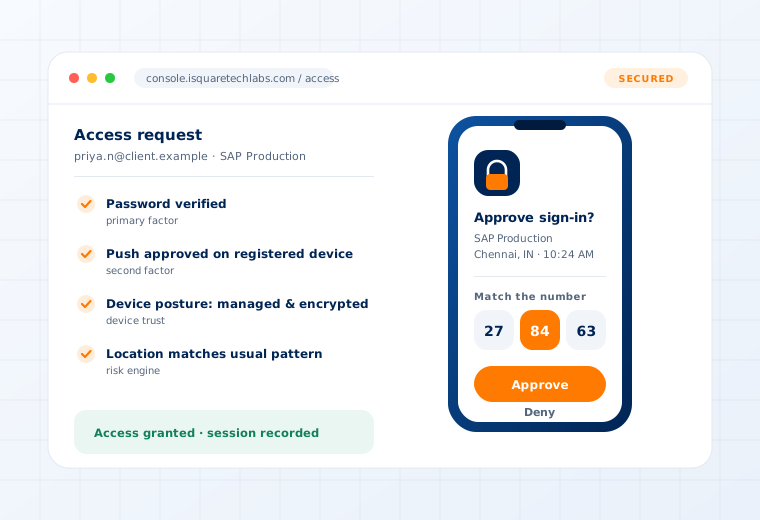
Access request verified through push approval, device posture and location checks

Supported

VPN platforms
OpenVPN · FortiGate · Palo Alto · standard RADIUS concentrators
Protocols
RADIUS · SAML · REST API
Auth modes
PUSH · QR · FIDO2 passkey · CR-OTP · TOTP · POTP · GRID
Policy signals
Device · location · geo-fence · behaviour
Questions

What buyers ask about this.

If yours is not here, our team will answer it directly.

Ask us
Almost certainly. Anything that can authenticate against RADIUS is supported, which covers OpenVPN and the mainstream firewall VPNs. No change to the concentrator beyond pointing it at the platform is normally needed.
Yes. Geo-fencing uses the GPS and A-GPS capabilities of the user's device, so you can permit access only within a designated office, or restrict a travelling employee to a defined set of countries.
That is exactly the signal you want. Real-time fraud alert lets the user reject and lock their account from the prompt itself, which stops the attack and tells your team the credential is compromised.
Related use cases

Often deployed alongside.

Remote Server Login

RDP · SSH · Jump hosts

Read more

Desktop & VDI

Windows · Linux · Horizon · VNC

Read more

Device Administration

Network · NetApp · Cisco ISE · OT

Read more

See this working on your own systems.

Bring the system you are worried about and we will show you exactly how this control would be applied to it.